When the autumn leaves reach their peak in November, Kyoto doesn’t go dark at sunset — it glows. Across the city, temples switch on special autumn illuminations (momiji light-ups), opening their gardens at night to visitors who come to see maples lit from below, reflected in still ponds, and framed against black skies.
These special evening openings run from roughly mid-November to early December (dates vary each year), and they’re one of the most spectacular — and most crowded — experiences Kyoto offers. Here’s how to see the best ones without losing your mind (or your tripod).
What Are Autumn Illuminations?
During peak foliage season, major temples and shrines hold special evening openings. The gardens are illuminated with carefully positioned floodlights and lanterns, and the leaves — red, orange, gold — take on a completely different character at night. Some venues add music, projections, or access to areas normally closed after dark.
Most illuminations run daily (or near-daily) for two to four weeks between mid-November and early December. Evening entry is usually from 17:00 to 20:30 or 21:00, with last entry 30 minutes before closing. Some venues close on certain nights for maintenance — always check the official site before heading out.
Best Spots: Dates, Times, and Prices
Here is the essential list for 2026. Windows and times are typical; confirm on official sites as your trip approaches.
| Venue | Window | Entry | Price |
|---|---|---|---|
| Tofuku-ji | Mid-Nov – early Dec | 17:00–20:30 | ¥1000 |
| Eikan-do | Mid-Nov – early Dec | 17:00–20:30 | ¥1000 |
| Kiyomizu-dera | Mid-Nov – early Dec | Extended hours | ¥400 |
| Kodai-ji | November | 17:00–21:00 | ¥600 |
| Kitano Tenmangu | November | 17:00–20:30 | ¥1000 |
Tofuku-ji
The undisputed king of autumn illuminations. Tofuku-ji’s famous Tsuten-kyo bridge spans a valley of hundreds of maples, and at night it becomes a sea of glowing red and orange beneath your feet. The colour intensity here is the strongest in the city. ¥1000, mid-November to early December, 17:00–20:30. Arrive at 16:30 to queue before opening — the bridge view is worth it.
Eikan-do
Eikan-do’s hillside layout means you can look out over the illuminated maples from above — a perspective unique in Kyoto. The mirror pond at the base doubles the display. It’s a gentle uphill walk that rewards you with the city’s most romantic night view. ¥1000.
Kiyomizu-dera
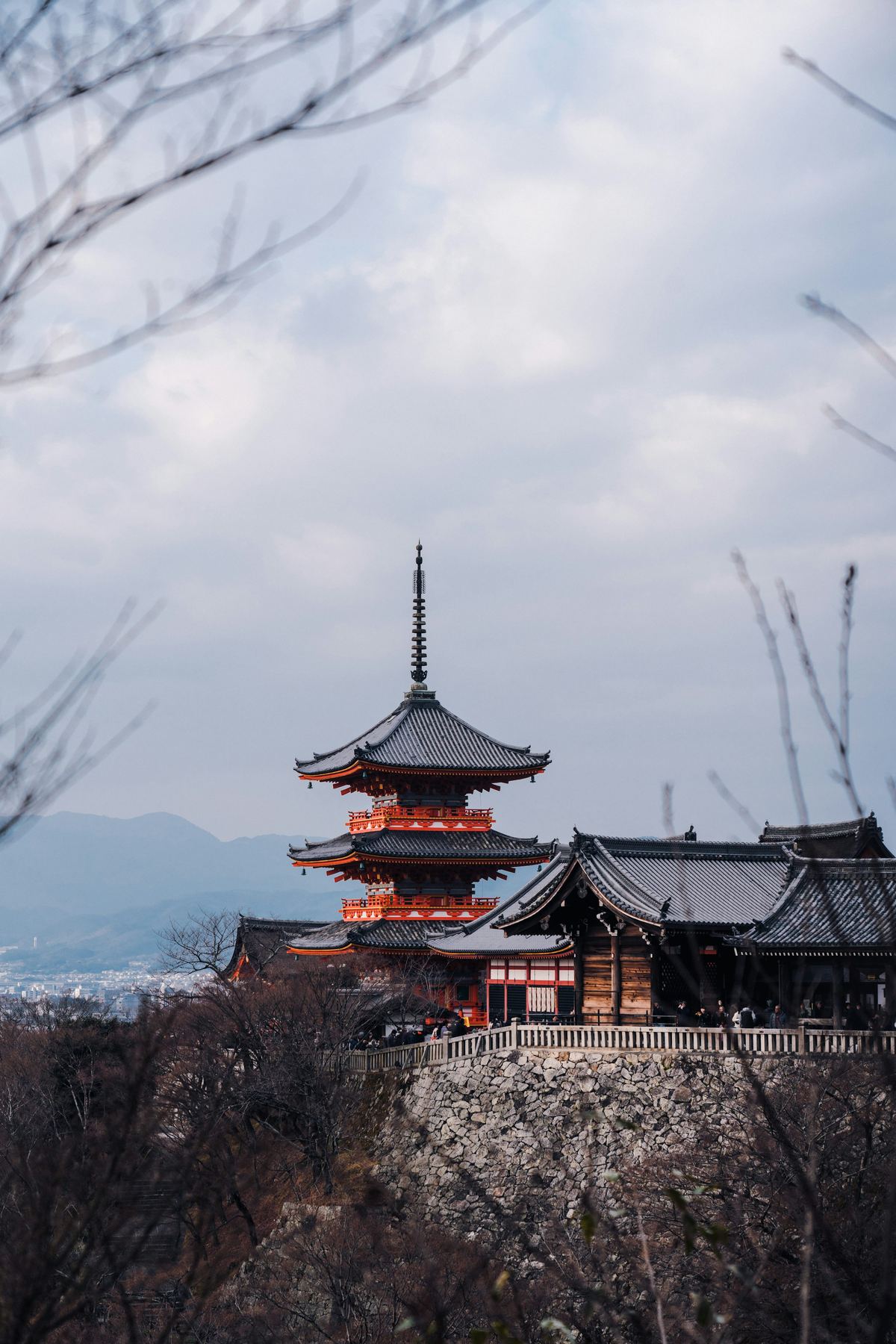
The iconic wooden stage is illuminated during autumn evenings — Kiyomizu keeps its normal ¥400 admission and simply extends its hours. From the famous stage you get an uninterrupted view over a sea of red maple, with the lights of Kyoto below. The sheer scale makes it a must.
Kodai-ji
Less famous than the big three, and that’s exactly why you should go. Kodai-ji stages a zen-garden illumination with subtle projection mapping on the stone garden, plus a beautifully lit bamboo-lined path. ¥600, peaceful, and close to the lantern-lined streets of Higashiyama.
Kitano Tenmangu
Japan’s most famous plum shrine also has a stunning momiji display — the maples within its grounds are dramatically illuminated in November. The open layout means fewer bottlenecks than Tofuku-ji. ¥1000.
Photography Tips
- A tripod is essential — illuminations are dark, and you’ll be shooting at one to four second exposures. Many venues allow tripods (check the rules); a monopod is a good compromise on crowded paths.
- Long exposures for reflections — ponds and streams double every composition. Shoot at f/8–11, ISO 100, and let the water smooth into silk over two to five seconds. The mirror reflections at Eikan-do and Tofuku-ji’s garden pond are the classic shots.
- Arrive early for the blue hour — 17:00 to 17:30 gives you that deep blue sky behind the first illuminated maples. It’s the single best window for colour contrast.
- Watch the white balance — warm tungsten light turns everything orange. Set white balance to around 4000K (or the “flash” preset) to keep the reds natural.
- Shoot through gaps — in the queues, look for framing through branches or railings rather than fighting for the front position.
How to Plan Your Evening
Don’t try to do everything in one night — you’ll spend it in queues. The sweet spot is two illuminations per evening, scheduled so the second is a short walk or one train from the first.
Sample itinerary: start at Tofuku-ji at 16:30 for the opening, capture the bridge at blue hour, then walk 15 minutes through the lantern-lit streets to Eikan-do for its hilltop view and mirror pond. Both sit in the eastern Higashiyama district, connected by the Philosopher’s Path — a beautiful evening walk in itself.
For Kiyomizu-dera: combine it with Kodai-ji and the Yasaka pagoda area, all within walking distance in eastern Kyoto. Buy a coffee, walk the lantern streets between venues, and finish with the panoramic night view from Kiyomizu’s stage.
Practical Tips
- Arrive 30 minutes before opening — the first entry wave gets the empty shots; by 19:00 the venues are shoulder-to-shoulder.
- Weekdays are dramatically quieter — if your schedule allows, aim for Monday to Wednesday evenings. Sunday and national holidays are the worst.
- Warm layers are essential — November nights in Kyoto drop to 5–10°C, and you’ll be standing still for long exposures. A thermal base layer, hat, and gloves make the difference between magical and miserable.
- Bring snacks — queues at popular venues can reach 30 to 60 minutes. A convenience-store onigiri and a thermos of tea are the pros’ move.
- Plan transport in advance — buses back from Higashiyama fill up at closing time. Consider the Keihan or Hankyu trains, or walk 15 minutes to a less-crowded stop.